WTS-Boston DEI-in-Motion: The Bystander Effect
November 2026
In the greater Boston area, it's much more common to be among people than be alone. As such, we tend to observe each other's behavior and often make decisions based on what we perceive will be the impression or judgement of others. This is the nature of living as a social species. We cheer those who step forward to aid a stranger, but it also can feel hard or awkward to do so ourselves when observing someone being harassed or having a possible medical emergency.
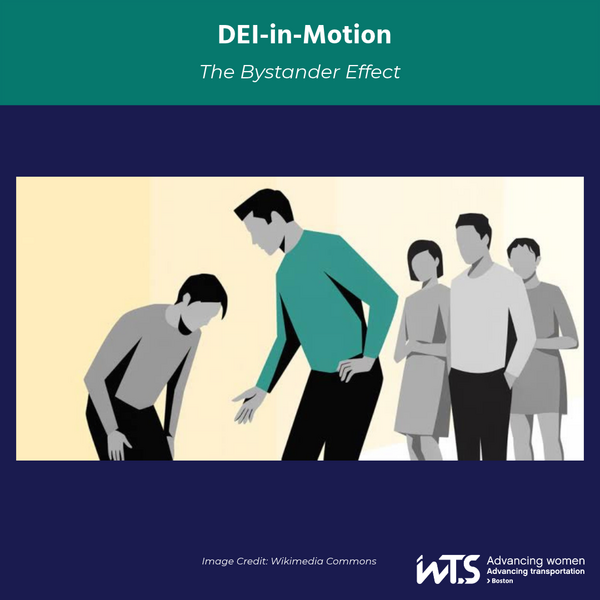
The bystander effect is a phenomenon where individuals are less likely to intervene or help in an emergency or active harassment when other people are present. Multiple studies have shown that people will act more decisively when alone than in groups [1].
This is caused by several factors. One is a diffusion of responsibility. As the number of individuals observing an event increases, the personal responsibility a single individual feels reduces as they assume someone else will step in. Another factor is pluralistic ignorance. Individuals will look to the reactions of other people in the area to gauge, consciously or not, whether the situation unfolding is an emergency. When everyone is looking to everyone else, it creates a paralyzing effect on the whole group. Finally, individuals will hesitate to step into an emergency out of a fear of social judgement or embarrassment [2].
To avoid being a bystander, the American Psychological Association promotes the motto: Be an Upstander. The APA also outlines the 5 D’s of intervention listed below [3]:
-
Distract: If safe to do so, diffuse the situation by interrupting the parties by starting small talk or making a loud commotion like dropping a large, loud object.
-
Delegate: Ask a third party, preferably an individual in a position of authority, to help you intervene in the situation. In a medical emergency, giving specific people specific tasks like calling 911 or retrieving an AED is more likely to result in action compared to appealing to the group at large.
-
Document: If it is safe to do so, and assistance is already being provided, write notes and/or take video to help document the situation for the victim and/or authorities.
-
Delay: Check in with the victim to offer your support and/or assistance if the victim wants to pursue legal action or report the incident to the authorities.
-
Direct: Once everyone is safe, speak firmly against the harassment that took place, but prioritize assisting the victim.
Some of these steps are more applicable to situations where harassment is the emergency at hand, but the willingness to interrupt a situation and ask how you can help is valuable regardless of the emergency. In cases of medical emergencies, immediate bystander action can greatly increase the victim survival rate [4].
Being aware of the bystander effect and mentally rehearsing steps you feel comfortable taking to overcome that initial hesitation and awkwardness can be an effective way to prepare yourself to step forward the next time you witness someone who might need assistance [5].
References:
[1] https://vptm.ehps.ncsu.edu/2025/08/13/bystander-effect-explained-how-your-brain-and-personality-play-a-role/
[2] https://www.psychologytoday.com/us/basics/bystander-effect#be-an-active-bystander [psychologytoday.com]
[3] https://www.apa.org/pi/health-equity/bystander-intervention [apa.org]
[4] https://www.redcross.org/take-a-class/resources/articles/bystander-cpr [redcross.org]
[5] https://www.americanscientist.org/article/overcoming-the-bystander-effect
Explore WTS-Boston's other pages here: WTS-Boston Homepage | News | Events