In Their Words: Two WTS Honorees Shaping the Future of Transportation
Written by, Deepika Fields, WTS-DC
They keep winning! Last winter, WTS-DC awarded a Chapter record of $37,000 in scholarships to 14 deserving students recognizing them for their academic achievements and excellence. The Scholarship & Fundraising Committee nominated four of these recipients for the WTS-I Foundation scholarships. Kelly Lige, who was awarded a 2025 WTS-DC $3,000 undergraduate student scholarship, was selected from an extremely competitive field to receive the WTS-I Foundation’s Sharon D. Banks Memorial Undergraduate Scholarship in the amount of $5,000. Additionally, Lidya Woldeyesus, who was awarded a 2025 WTS-DC $500 and WSP $2,500 scholarship in the Graduate student category was selected as recipient of the WTS-I Strategic Partner Scholarship sponsored by WSP. Both of these remarkable award recipients were recognized at the 2026 WTS International Annual Conference Gala held earlier this month in Los Angeles, CA. It was great to catch up with them recently and dive into a little Q/A about what inspires and excites them in Transportation!
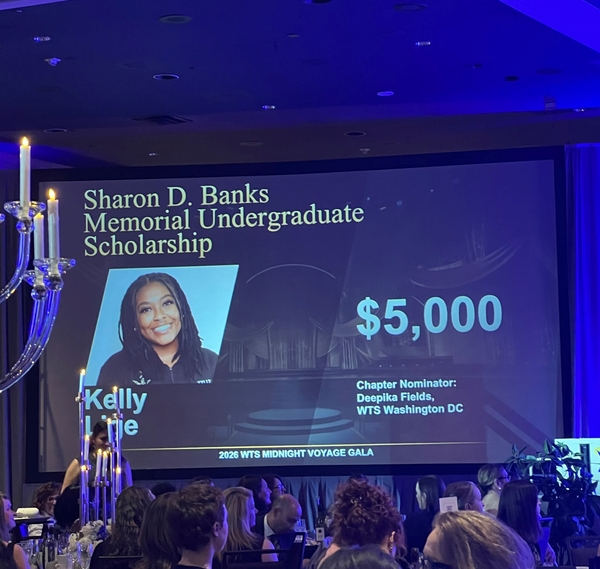
Kelly Lige, B.S. Civil and Environmental Engineering, Howard University ’26
Q: What inspired you to pursue a career in transportation?
As someone who has taken a non-traditional approach to transportation, I feel like this field chose me. My background is rooted in water resources, but I realized that transportation systems are fundamental to how communities function. My drive to make systems work for the people most affected by their failures aligned with the evolving world of transportation.
Q: What does receiving these scholarships mean to you?
Receiving these scholarships is an honor that supports my dedication for equitable infrastructure. It provides support as I transition from my undergraduate studies into my professional career. It also connected me to an empowering network of women leaders who are paving the way in this industry.
Q: What area of transportation are you most interested in and why?
I am most interested in the intersection of roadway design and water resources engineering, specifically drainage and stormwater management. Roadway infrastructure impacts metropolitan areas like Washington, D.C., and it must be built with climate change and flood resilience in mind.
Q: What unique perspective do you bring as a woman entering this field?
My unique experience as a Black woman in engineering provides me with a lens that explicitly centers equity and long-overdue change. Historically, transportation and environmental harms have disproportionately burdened Black and Brown communities. I bring a perspective that recognizes this history and insists on repairing it.
Q: What advice would you give to other young women considering transportation careers?
Remember that your perspective is necessary. Don't be afraid to take an untraditional path or blend your specific passions with engineering. Strive for technical excellence but always value your human impact. The field needs leaders who are committed to making systems work for the people, so trust that your voice is exactly what the industry needs to move forward.
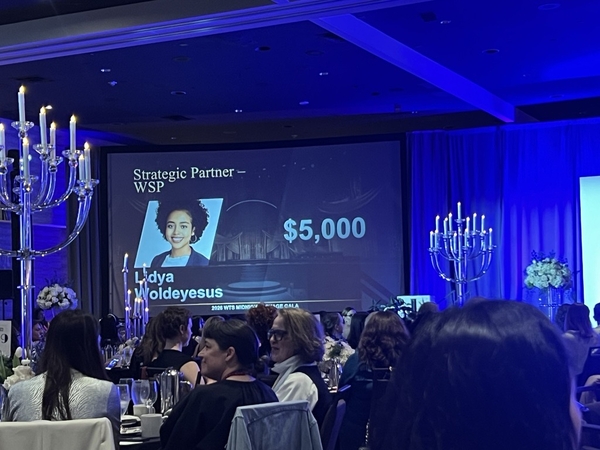
Lidya Woldeyesus, MPS Urban and Regional Planning, Georgetown University ‘26
Q: What does receiving these scholarships mean to you?
Words cannot fully express my gratitude for the scholarships I received through WTS-DC and WTS International. As a first-generation college and graduate student, this support played a meaningful role in helping me complete my degree. Beyond the financial assistance, it has been incredibly inspiring to join a community of talented and driven women who are committed to shaping a more equitable and innovative future for transportation. Being welcomed into this network has affirmed my passion for the field and encouraged me to continue pursuing work that creates lasting impact.
Q: What advice would you give to other young women considering transportation careers?
Follow your passions and remain curious. The transportation industry is incredibly broad, offering opportunities in areas such as transportation planning, traffic engineering, community engagement, construction, geospatial analysis, sustainability, and more. If you are in school, use your assignments and projects as opportunities to explore questions that genuinely interest you and to develop new technical and analytical skills. One of the most valuable experiences in my journey was joining WSP as an intern on the transportation planning team the summer before and throughout my final year of graduate school. That experience gave me the opportunity to better understand what a career in transportation could look like and helped solidify my excitement about entering the field.
Q: Who has been most influential in your academic or career journey so far?
Without question, my parents have been the most influential people in my journey. My family is from Eritrea, and our culture deeply values perseverance, education, and hard work. Although my parents were not able to pursue higher education themselves, they dedicated their lives to ensuring their children would have opportunities they did not. My father worked long hours as a taxi driver in Washington, D.C., and my mother worked as a nurse assistant, all while encouraging my siblings and I to dream big and pursue meaningful careers. Their sacrifices and unwavering support inspired me to earn a B.A. in Political Science and Civic Studies from Tufts University and, as of last week, my Master’s in Urban and Regional Planning from Georgetown University. More importantly, they instilled in me a commitment to using my education and career to positively impact communities that have historically been marginalized.
Q: What’s one project, class, or experience that confirmed this was the right field for you?
One experience that deeply affirmed my passion for transportation planning was my Quantifying Urban Mobility course with Professor Kenneth Joh. For my final project, I studied first- and last-mile transportation challenges faced by transit riders in Washington, D.C., focusing on disparities between the city’s lowest-income and highest-income wards. Using data from the 2017/2018 Regional Travel Survey administered by the Metropolitan Washington Council of Governments, I found that residents in Wards 7 and 8 experience significantly longer travel times and rely more heavily on buses to access Metrorail stations. Despite having higher transit usage, these communities continue to face infrastructure gaps and poor walkability that create additional barriers to mobility. This project reinforced my understanding that transportation inequities are not accidental, but are in fact shaped by historic disinvestment and car-centered planning decisions. It also showed me how transportation data and spatial analysis can be used to tell meaningful stories about inequity and advocate for more just and accessible transportation systems.
Q: Where do you see yourself making an impact in the next 5–10 years?
Growing up as an Eritrean immigrant in the United States shaped my awareness of how deeply geography influences opportunity and access. I have seen firsthand how something as simple as a reliable bus route, or the absence of one, can determine whether someone reaches work, school, or healthcare on time. That personal understanding continues to fuel my professional interests and aspirations. I am especially interested in transportation challenges across both the United States and Sub-Saharan Africa, where rapid urbanization and uneven infrastructure investment present urgent challenges as well as opportunities for innovation. In the long term, I hope to work at the intersection of mobility and justice, helping cities build transportation systems that are more resilient, inclusive, and community-centered. No matter where my career leads, I hope to bring empathy, curiosity, accountability, and technical expertise into every project I contribute to. In the short term, however, I am excited to begin my transportation planning career with WSP next month!