WTS-Boston DEI in Motion: Winter Travel and Accessibility
December 2025
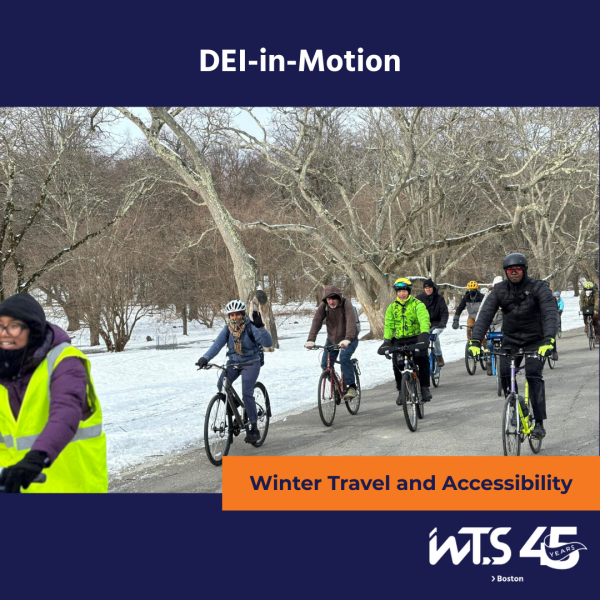
As temperatures drop and the days get shorter, moving from place to place becomes more challenging. For those with disabilities, winter weather presents greater than the usual challenges. Shorter days mean commutes in the dark for many people, regardless of mode of travel.
Winter weather usually results in sidewalks, roads, and other pathways with slick surfaces that are often narrowed or even blocked entirely. Salt spray can obscure signs, making wayfinding difficult. When sidewalks and shared use paths are blocked, that forces users into the road - making conflict with vehicular traffic more likely. Those who rely on walking, biking, and other micromobility methods may forgo travel entirely, even necessary travel.[1]
While walking, biking, and mass transit means that there are fewer people on the roads, winter weather typically means sidewalks and shared use paths require more innovative methods when planning for snow and ice removal.[2] The truck mounted snowplow is a common solution for roads, but most communities rely on much slower and less efficient methods for non-vehicular routes. This often results in sidewalks and shared use paths remaining covered in snow and ice well after roads have been cleared.
Transportation equity focuses on making mobility and accessibility fair for all users in a community. Currently there are few metrics that include seasonal weather conditions as a part of the calculation to determine how user friendly a particular path is. There are tools in development that make use of the EPA's National Walkability Index and bike-ability metrics to show where and how people move[3] . Using these kinds of metrics can improve plowing programs by capturing the movement patterns of all road users, not just vehicular.
Planning for a robust and equitable transportation network means considering the winter days, not only the summer ones. Combining transportation metrics with the NWI with snow removal planning is an important step towards improving winter mobility for all users.[4] A prioritization system that includes not only roads, but also high traffic walking and bike routes will allow municipalities to equitably serve all users regardless of the season.
As winter approaches, consider these suggestions to keep yourself and those around you safe while travelling [5] :
• Fully clean the sidewalks, drain inlets, and curb cuts around your home to provide safe travel paths if you are able to do so.
• If able, assist your neighbors in clearing their paths.
• Report blocked paths to the appropriate authorities.
• Wear bright colored and/or reflective coating when travelling at night or in low visibility conditions.
• Take smaller, slower steps to prevent slipping on slick surfaces.
• When driving, use headlights and wipers to improve your visibility in low light conditions.
• Wear shoes or boots with traction aids.
• Add extra time for travel.
Sources:
[1] https://wid.org/winter-accessibility-woes/
[2] https://walkmass.org/wp-content/uploads/2018/03/WalkBoston-SnowRemovalReport.pdf
[4] https://www.mass.gov/doc/measuring-access-to-improve-public-health-phase-ii-summary/download
Explore WTS-Boston's other pages here: WTS-Boston Homepage | News | Events