WTS-Boston DEI in Motion: Equal Pay Day
April 2026
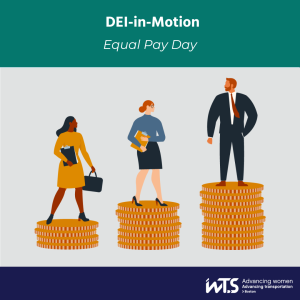
Equal Pay Day represents how far into the next year an average woman would need to work to earn the same amount as a man in the same position. The calculation considers differences in hours worked, cost of living, and other discrepancies to ensure that the comparison is an accurate representation when compared to a man working the same job, with the same hours, in the same area [1].
The wage gap comes from a variety of systemic factors. One factor is a lack of pay transparency in most jurisdictions, which makes it difficult to negotiate fair wages. Wage disclosure laws at the local and state level are improving pay transparency. Another factor is occupational segregation, where due to various systemic factors, women are over-represented in lower paying occupations compared to men. Finally, pay discrimination is a major factor in the wage gap. Lack of pay transparency makes it difficult to spot and act against pay discrimination [2].
With the passing of the Equal Pay Act in 1963, the intent was to eliminate all discrimination in pay, so that workers of equal skill and seniority would be paid the same for one hour of work regardless of race, sex, or marital status. Prior to the passage of this law, employers could change the pay rate for a job based on their own preferences. This meant that a single woman could be paid differently than a married man for working the same job with the same hours. At that time, the average woman was paid about 60 cents for every dollar a man was paid for doing the same work [3]. The Equal Pay Act specifies that the job content, not title, determines whether a job is "substantially equal" and subject to examination under the Equal Pay Act. Under the Equal Pay Act, employees who feel they are victims of wage discrimination have a maximum of two years to sue their employer directly for the lost wages or file a wage complaint with the Equal Employment Opportunity Commission [4].
The National Committee on Pay Equity was founded in 1979 as a coalition of women's and civil rights organizations, labor unions, and professional organizations with the goal of closing the gender and race pay gap [5]. Today, the average woman is paid about 83 cents for every dollar a man is paid [6]. Over the 63 years since the Equal Pay Act was passed, the pay gap has closed about 23 cents. To highlight the continued gender pay gap, the committee decided to create a day of awareness: Equal Pay Day.
The first Equal Pay Day was acknowledged on April 11, 1996. At that point, women were paid an estimated 75 cents for a dollar a man was paid [7]. Equal Pay Day 2026 was calculated to be March 26, representing 16 days of progress in the 30 years since the day was first acknowledged. When broken down further by ethnicity, parental status, and/or gender identity, Equal Pay Day falls even further into the next year. Mom's Equal Pay Day will be on August 6th, Black Women's Equal Pay Day will be on July 21st, and Disabled Women's Equal Pay Day will be on October 20th [8].
The wage gap is slowly improving, but there are steps that can be taken to continue to make progress towards equal pay. Legislation to improve pay transparency, hold employers accountable for pay discrimination, and conduct wage audits on public contracts has been shown as effective in the fight against the wage gap. Another step is to advocate for a fair wage for all work, so even lower paying occupations receive an equitable wage. Implementing paid family leave and affordable childcare options can also improve the wage gap by making it easier for families to decide how to best balance their home and work responsibilities [9].
Sources:
[1] https://en.wikipedia.org/wiki/Equal_Pay_Day
[2] https://www.equalpaytoday.org/equalpaydays/
[3] https://www.qualtrics.com/articles/employee-experience/timeline-gender-…
[4] https://www.eeoc.gov/equal-paycompensation-discrimination
[5] https://www.pay-equity.co/about-history.html
[6] https://www.qualtrics.com/articles/employee-experience/timeline-gender-…
[7] ibid
[8] https://www.aauw.org/resources/article/equal-pay-day-calendar/
[9] https://www.equalpaytoday.org/gender-pay-gap-statistics/
Explore WTS-Boston's other pages here: WTS-Boston Homepage | News | Events